The Last Believable Election
Persuasion became free. Democracy now has to prove it can be more than performance.

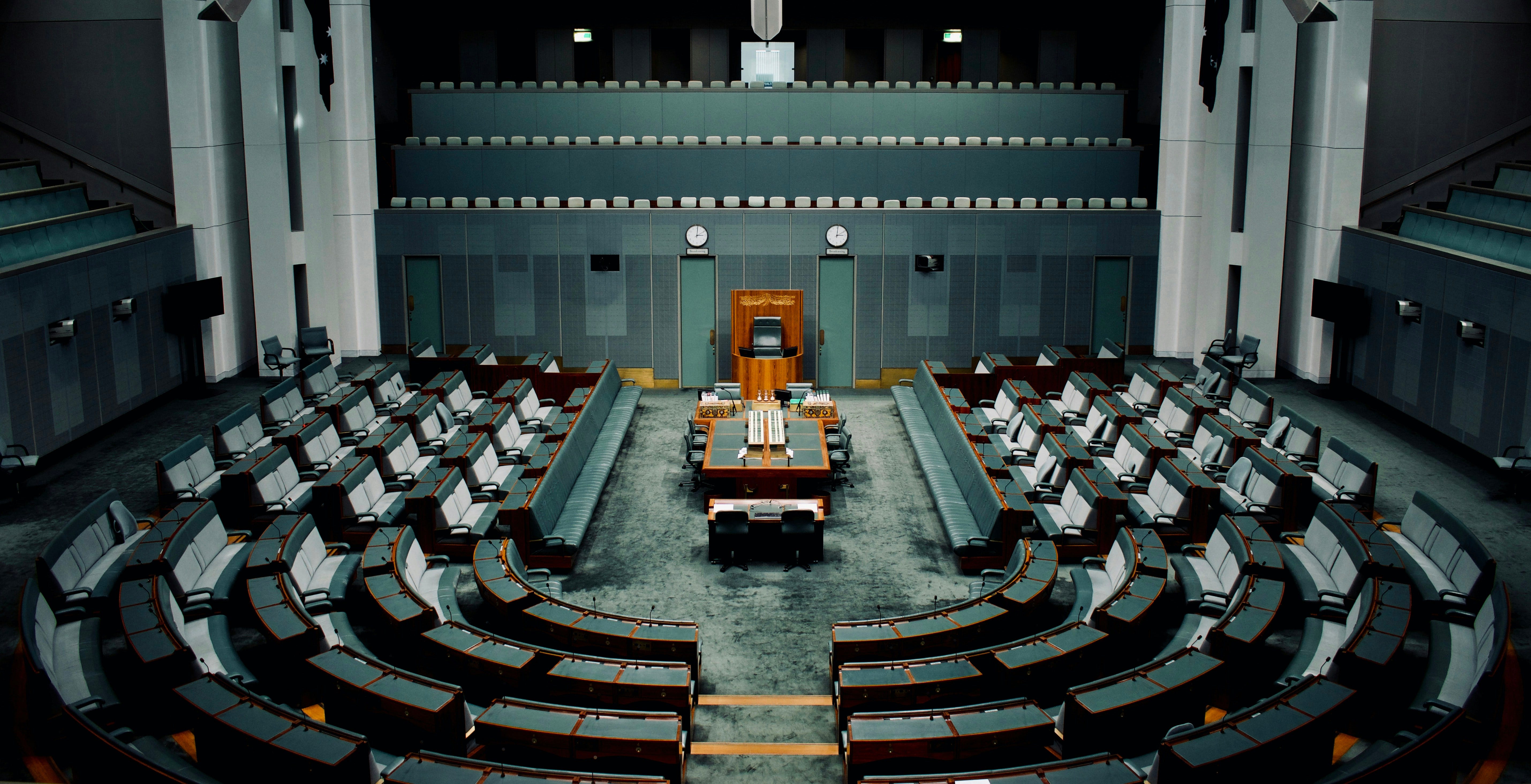
Somewhere, perhaps in your country, the election of 2036 will look exactly as elections are supposed to look. The polling stations will open on time. The queues will form in the rain. The cameras will pan across them. The anchors will explain in calm voices that the system held. And inside that orderly procedure the consequential decisions will already have been made, months earlier, by people you do not know, using systems you cannot see, on the basis of stories tailored to you alone.
This is not a prophecy of dictatorship. Dictatorship is the easy outcome to imagine, and the unlikely one. The harder outcome, already underway in several countries that still describe themselves as democracies, is a politics that keeps every visible feature of self-government while emptying out the conditions that made self-government possible: shared attention, shared reality, shared accountability. The form continues. The substance leaks away in a direction no camera is pointed.
Most of the alarm about artificial intelligence and democracy is aimed at the wrong target. It is aimed at the deepfake before the vote, the synthetic robocall on the morning of the primary, the bot army arguing in your comment thread. These are real, they have already happened, and they matter. They are also the surface of an older problem that AI accelerates rather than invents.
The older problem is that representative democracy has always been, in its working parts, a system of organized fiction.
The arithmetic of self-government
The arithmetic alone disposes of the romantic picture. If you spent sixteen hours a day, every day, for eighty-five years, speaking to a new person every thirty minutes, you would die having met fewer than a million human beings. A member of the European Parliament represents roughly that many. A senator from a large American state represents forty times more. The idea that a representative knows the people they represent is, in any literal sense, false. What sustains the relationship is a story, mutually agreed upon, about what knowledge would feel like if it existed.
This is performative democracy, and it has always been with us. It is the part of self-government that runs on shared fictions: that the rich and the poor have equal political rights despite radically unequal economic ones, that we consent to laws we have never read, that majorities exist in legislatures elected by minorities. The fictions are not contemptible. Take them away and the whole thing collapses. They allow strangers to be governed without ruling each other by force. They are also, like any fiction, rewritten by whoever controls the medium in which they are told.
How democracy became the default, and why that should not comfort us
Amartya Sen observed that democracy has become, for the first time in human history, the default language of political legitimacy, the regime that even autocrats feel obliged to impersonate. Governments that crush dissent now hold elections. Parties that win with a third of the vote pretend the other two thirds consented by staying home. The pretense itself is a tribute. No previous era required its strongmen to dress as democrats. That achievement, the universal acknowledgement that legitimate rule must at least pretend to flow from the governed, is one of the great moral inheritances of the past two centuries.
It is also an inheritance easier to lose than to earn, and we should remember how thin it is. Most humans who ever lived were ruled by people they neither chose nor could remove without bloodshed. The vote in Britain was confined to a sliver of property-owning men until 1918. American women voted nationally only in 1920. Black Americans were violently disenfranchised in the South until the 1960s. Switzerland, the postcard republic, withheld the federal vote from women until 1971. Across the world the number of countries that hold meaningful elections has fluctuated for a hundred and fifty years, expanding after great wars and contracting in their long aftermath. Freedom does not march. It seeps in where conditions allow and recedes when they do not.
Zhou Enlai, asked about the consequences of the French Revolution, is said to have answered that it was too soon to tell. The line is almost certainly a translation error; the Chinese premier seems to have thought he was being asked about Paris in 1968, not 1789. The misunderstanding has outlived the correction because the answer, applied to the larger question, still feels true. We do not yet know what the French Revolution did. The same will be said of what AI does to politics, and the verdict, when it comes, will not arrive in our lifetimes. What we can say already is that the systems we inherited were built when manipulation was slow and expensive. Both conditions are ending at the same time.
What AI actually changes
In January 2024, voters in New Hampshire received a robocall using a synthetic clone of the American president’s voice, urging them not to vote in the primary. In 2023, in Slovakia, an audio fake of a candidate discussing vote rigging surfaced two days before the polls opened, during the legally mandated silence period when journalists could not respond. In Indonesia, a generated video resurrected a former president, dead since 2008, to endorse the party of the eventual winner. Each of these episodes failed, in the narrow sense, to swing its election. Each succeeded in the wider sense of making truth a fraction more expensive to establish and falsehood a fraction cheaper to circulate. The trend line, not any single case, is the story.
The naive worry is that machines will flood the public square with lies until truth becomes indistinguishable from noise. This is happening, it is bad, and it is also not new. Edward Bernays managed something similar with newsprint and radio in the 1920s, and the technologies of mass persuasion have been refined every decade since. What AI changes is how cheap this all becomes. The price of a persuasive lie, tailored to one human being and updated in real time as that human reacts, is collapsing toward zero. So is the cost of monitoring how that human responds. So is the cost of doing both for billions of humans at once.
This is the asymmetry that matters. AI is an instrument that compounds the advantages of whoever already has scale. The metaphor of the neutral hammer fails here. A campaign with a thousand staffers becomes a campaign with the productivity of ten thousand. A platform with a billion users becomes a platform with the computing power to model each user individually. A central bank, a hedge fund, a presidential office, an oil major: each of these can now run experiments on the human nervous system at a tempo no opposition party, no civic association, no labor union, no neighborhood assembly can match. The instrument meant to democratize knowledge is, in practice, concentrating the power to direct attention.
The danger lies a step further on. AI makes it cheap for organized factions to keep the unorganized majority entertained, anxious, and divided while the consequential decisions are made elsewhere. Some of those factions want a return to a world before 1789, in which rule by the well-born was simply assumed. Others want to leap past democracy into a managerial technocracy in which elections continue but no longer decide anything important. They disagree on aesthetics. They agree that ordinary people should not be in the room when the room matters.
Performance without substance
The political theorist Sheldon Wolin used the term inverted totalitarianism for a system in which government is ignored by its citizens rather than overthrown by them, while corporate and bureaucratic power fills the vacuum. It is authoritarianism without a dictator, without a single moment of seizure, without anyone obvious to blame and therefore without anyone obvious to resist. Wolin was writing before generative AI existed. He was describing a system whose friction AI is in the process of removing.
You can already feel the texture of it. There are elections. There are parliaments. There are constitutions printed on good paper and recited at school assemblies. There is a press that calls itself free, and in some respects still is. None of this materially constrains the exercise of power on the decisions that matter most: who pays for the energy transition, who absorbs the costs of automation, who is permitted to know what about whom, who decides which weapons are built and pointed where. You can vote, and the options were preselected by forces you cannot see. You can speak, and the systems that decide who hears you optimize for engagement rather than judgment. You can protest, and the protest will be absorbed into the content cycle and forgotten by Thursday.
The line between performative democracy and the real thing is not always obvious from the inside. That is what makes it dangerous. If you woke up one morning in a country where elections no longer mattered, how long would it take you to notice? If you are not sure, you may already be there.
The attention emergency
If the diagnosis is right, the great problems of this century, climate stability, pandemic prevention, nuclear risk, the governance of AI itself, are not unsolved because we lack the relevant knowledge. We have known what to do about climate change since the 1970s. We have known what to do about pandemic preparedness since SARS in 2003. We have known what to do about nuclear weapons since Bernard Brodie wrote in 1946 that the chief purpose of military establishments would from then on be to avert wars rather than win them. The knowledge is sitting on a shelf in any decent library. What is missing is the sustained, coordinated attention required to act on it.
This is the real emergency, and it sits upstream of every other. Sustained attention is the foundation on which collective action is built. Without it, no policy can be made durable, no institution can be reformed, no movement can hold a line. With it almost any solvable problem becomes solvable. The grim joke of our century is that we have invented technologies of attention capture more powerful than anything in human history, and we have invented them at precisely the moment when we most needed the opposite: technologies of attention coordination, capable of focusing the eyes of strangers on the same horizon at the same time.
A serious response would treat this as the public-health problem it is. We built an Intergovernmental Panel on Climate Change because we eventually decided the planet’s carbon balance was too important to be left to whichever lobbyist had lunch with whichever minister. We do not yet have a comparable body for our shared attention, and the case for one is no weaker. Such a body would not censor; it would measure. It would track, across countries and platforms, what citizens are being asked to look at, by whom, with what effect on their capacity to act together. It would publish, in language a fourteen-year-old could act on, the state of our collective ability to deliberate. It would not save democracy. It would make it possible to see whether democracy was still alive.
The cost of knowing alone
There is a failure mode common among the people most likely to be reading this. Call it the scholar’s consolation. It goes like this: if I read enough, write enough, study enough, my contribution to the world is complete. The world’s problems are problems of knowledge, and I am a knowledge worker, therefore my work is the world’s solution. This is a flattering theory. It is also wrong.
The problems that will define this century are problems of organization. The mathematics of climate change has been understood for longer than I have been alive. The epidemiology of airborne pathogens has been understood since John Snow mapped cholera in Soho in 1854. The instability of nuclear deterrence under arms-race dynamics was modeled by Thomas Schelling sixty years ago. We do not lack ideas. We lack the capacity to act on the ideas we already have, at the scale at which they need to be acted upon, across borders we did not draw and over time horizons longer than the next election.
To organize is harder than to know, for a specific reason. Knowing can be done alone. Organizing cannot. Knowing is rewarded by tenure, citations, retweets, the small warmth of being seen to be right. Organizing is rewarded, when at all, by outcomes that arrive years after the work was done and that are usually credited to someone else. A society that asks its most capable young people to optimize for individual recognition will produce many brilliant essays and very few institutions. We are living in the result.
Honesty is the corrective. Asceticism and self-punishment have nothing to do with it. Look at how you actually spend your days rather than how you describe them. The way you spend your days, Annie Dillard wrote, is the way you spend your life. If the honest accounting reveals that almost all of your effort is going into building your own reputation and almost none of it into building something that would outlast you, you have not been bad. You have been normal. The question is whether you intend to remain normal.
Organizing the convinced
There is a tempting fantasy in which the work of the century is to convince the unconvinced. To argue the climate denier into accepting science, the autocrat into respecting elections, the billionaire into paying his taxes. This makes a fine hobby. It does not make a strategy. The movements that have actually changed the world did not win by converting their opponents. They won by organizing the people who already agreed with them better than anyone had organized them before. Polls from the early 1960s show that a majority of white Americans opposed the March on Washington. The civil rights movement did not wait for that majority to change its mind. It built the discipline, the coalitions, and the willingness to suffer that made the law catch up. The abolitionists did not persuade the slaveholders. They built a coalition large enough to outvote, outfight, and outlast them. The suffragettes did not win over the men who beat them in the street. They built networks no beating could dissolve. The Indian independence movement did not change the mind of the British Raj. It raised the cost of the Raj’s continuation past what the Raj could pay.
The convinced today are already a vast number. There are hundreds of millions of people who know that the climate is warming, that pandemics will recur, that the nuclear status quo will not hold forever, and that extreme poverty is both a moral scandal and a strategic loss of human potential. They are scattered across continents, ideologies, languages, professions. They are barely in contact. Each, in the small hours, believes someone else is doing the real work. Nobody is doing the real work. There is no adult in the room. There is only us.
This is the opposite of a counsel of despair. If the bottleneck were knowledge we would be in trouble, because making new knowledge is slow and expensive. If the bottleneck were resources we would be in trouble, because reallocating them is politically explosive. The bottleneck is organization, and organization is something humans have been good at for tens of thousands of years. We built cities, religions, corporations, and trade routes that crossed continents. We can build the institutions this century requires. We have simply not yet chosen to.
What organizing looks like, in practice, is unglamorous. It looks like five people who meet for an hour every week, take the three claims that dominate the local group chat, trace each to its source, and publish what they find on a single page neighbors can read in a minute. It looks like translating a council budget with AI and reading the relevant page aloud at a bus stop where parents wait for the school bus. It looks like funding a piece of local journalism that names a specific official’s specific failure. It looks like joining a political party in order to make it less ridiculous, rather than denouncing politics from a comfortable distance. It looks like building things that have members, a memory, a budget, and a habit of meeting. Most of what has ever been accomplished by human beings has been accomplished by such groups. Almost everything you admire was built by one.
Frederick Douglass observed that power concedes nothing without a demand. The version this century requires is the same sentence in a different key. Attention concedes nothing without organization. The most sophisticated attention-capture machinery in history will not be overcome by the unorganized goodwill of well-read individuals.
What you are choosing
None of us chose to be born, to be born human, to our particular parents, in our particular country, in this century rather than another. The conditions of our existence were dealt to us. What we choose is what to do with the hand. A long life contains roughly thirty thousand days. You have spent some of them already. You will spend the rest doing something. Your life will be used. The honest question is by whom, and for what.
If we fail in this century, it will not be because we lacked the knowledge to succeed. The knowledge is published, peer-reviewed, available in libraries any phone can enter. We will fail because we let small differences inside the convinced minority become larger than the chasm between that minority and the future it claimed to want. We will fail because we mistook the performance of politics for politics. We will fail because we waited for permission from people who were never going to give it.
If we succeed it will not look like a movie. There will be no signing ceremony, no balcony speech, no single moment of triumph. It will look like a hundred thousand unglamorous decisions to organize rather than complain, to teach rather than perform, to build institutions that outlast their founders, to tell, again and again, the story that human dignity is not negotiable and that the cost of inaction is paid by the people with the fewest choices. It will look like the same hard, deeply human work that built every previous expansion of freedom, done by people who did not wait to be heroes before they acted like one.
Václav Havel, who learned about totalitarianism from inside it, wrote that the salvation of the human world lies nowhere else than in the human heart, in the human power to reflect, and in human responsibility. He meant that systems can be designed to absorb almost any resistance except the resistance of people who refuse to live within the lie. AI will be used to make the lie more comfortable. It will personalize the lie, optimize the lie, deliver the lie in your dialect, with your jokes, at the hour you scroll. The defense is people who refuse the lie even when refusing is inconvenient and even when refusing makes them look unfashionable in front of their friends.
The last believable election may already have happened. We will only know in hindsight. What we can know now is that the question facing the next one is no longer who builds the best fake. It is who builds the best room: a room with members, a memory, a budget, and a habit of meeting, large enough to make a demand and disciplined enough to outlast a news cycle. Most of the rooms that mattered in the last two centuries were built by people who did not feel ready, did not have permission, and did not know in advance that they would be remembered.
Zhou Enlai’s interpreter was right. It is too soon to tell. But the people who decide are the people who show up, and they are showing up now, on both sides of every question that matters. The only question left is which side you will be remembered for, if you are remembered at all, and whether, when your grandchildren ask what you did in the years the world was being decided, you will have an answer that does not embarrass you.
The way you spend your days is the way you spend your life. Spend them well.